
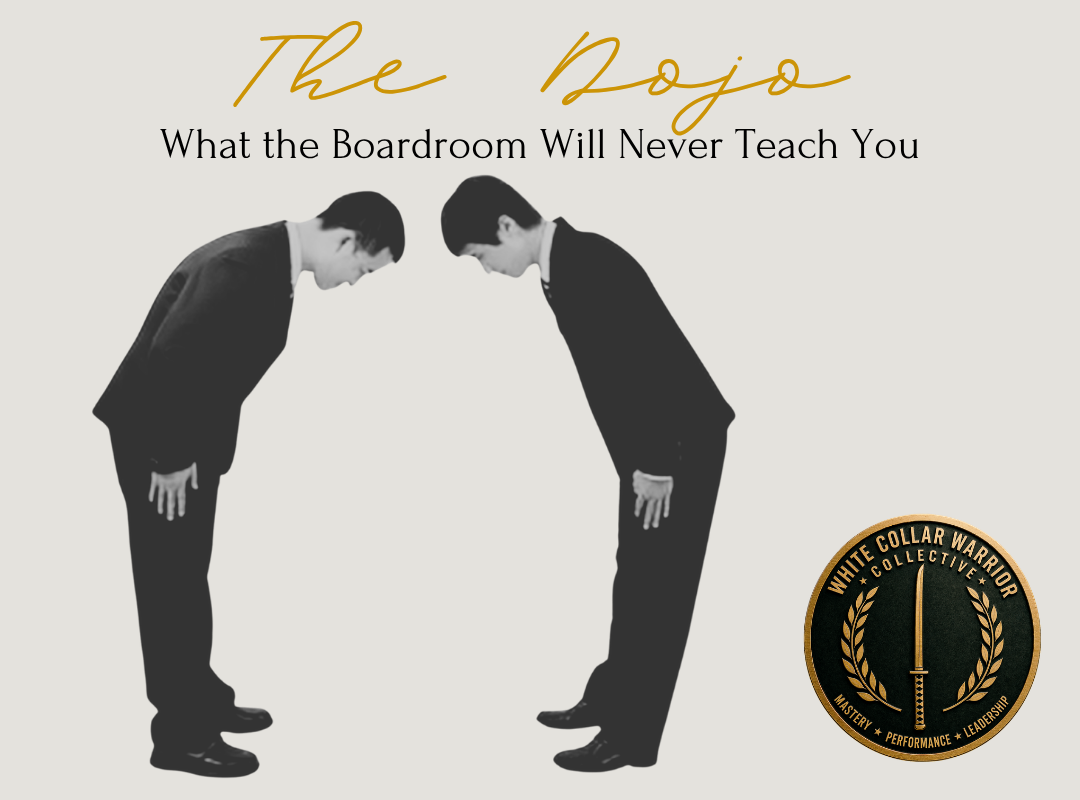
The boardroom rewards hierarchy. The dojo dissolves it.
Walk into a boardroom and the architecture of the room tells you everything: who has the power, where the power is positioned, how the power is to be respected. The head of the table. The corner office. The status signals that every participant reads within the first thirty seconds. Even in the most progressive organisations, the hierarchy is present — encoded in deference, in airtime, in whose observations land and whose are politely absorbed and forgotten.
Walk into a dojo, and something different happens.
The titles disappear at the door. The credentials are irrelevant. The years of professional achievement, the performance record, the salary — none of it exists inside this space. There are only men in training. And the law of the training floor is simple: what you are willing to work on, honestly, right now, is the only thing that matters.
This is not idealism. This is one of the oldest technologies for human development in existence.
The dojo model — structured practice, shared code, earned advancement, collective accountability — predates modern coaching by several thousand years. It produced warriors, scholars, monks and leaders across every civilisation that understood the difference between knowledge transmitted and wisdom forged.
Knowledge can be transmitted in a seminar. Wisdom requires a crucible.
The crucible of the White Collar Warrior Collective is designed specifically for the professional man. Three pillars — Self-Mastery, High Performance, Conscious Leadership — each with a foundation programme, a philosophy, a practice and a certification pathway. Not claimed by attendance. Demonstrated through competency.
Because the world already has too many men who know the theory and cannot embody it when the pressure is real.
The dojo is where the gap between knowing and being gets closed.
Ego stays outside. Training begins inside.
— Sifu Lak Loi, Founder, White Collar Warrior Collective